REVIEW: The Hidden (1987)

hidden

Take me to your leader… of this strip club.

The Hidden: B-

Socrates: Glaucon, my dear friend, I am curious about this film we’ve recently viewed together, The Hidden. It appears to be an amalgamation of borrowed elements from other movies, yet I enjoyed the film while you did not. Tell me, in your view, what is the essence of this cinematic creation on which you base your logic?

Glaucon: Socrates, it is a tired blend of familiar concepts. It borrows the premise of “Good Guy vs. Bad Guy from Another World” from my favorite film The Terminator and the idea of “Who’s the Monster in the Room?” from my other favorite movie The Thing. These elements, combined with mediocre production quality akin to Chuck Norris movies from this era, form a somewhat mindless experience that lasts for a full 90 minutes, yet I must admit I found it difficult to look away, which I cannot explain.

Socrates: Fascinating, indeed. But what strikes me as curious is that despite its conscious replication of other films, The Hidden garners widespread respect and praise. From esteemed critics like Roger Ebert to the faceless reviewers on Amazon.com, the film is spoken highly of. Do you not find it perplexing that a work that, as you believe, strips away the depth and meaning from its source material is celebrated as a solid film? How can you explain this paradox, Glaucon?

Glaucon: Indeed, Socrates, The Hidden deliberately replicates the plots and tropes of The Terminator and The Thing, yet it lacks the deeper allegorical and philosophical messages present in those films. While one may argue that these aspects were superficial in the aforementioned works, they were at least present and readable to some extent. The Hidden, however, revels in the futility of its own repetitive violence.

Socrates: Ah, an interesting observation, my friend. It appears you believe that The Hidden indulges in gratuitous destruction without offering any profound reflections on the human condition. I would like to return to this point in a moment, but if I may inquire further, could you shed light on the facets of the film’s premise – this tale of a parasitic alien criminal who possesses human hosts – that inspired your condemnation?

Glaucon: This is easy, Socrates! This alien parasite displays impulsive behavior, akin to the uncontrolled desires of the human Id, going on a rampage through the lens of a cheaply produced film. Possessing various hosts, the creature behaves in an extremely destructive and distressed state, as if consumed by the effects of methamphetamine. The campy depiction of a spree of grand theft auto, armed robbery, and assault is not art. The violence is meaningless and we’ve seen it in hundreds of other films before. It is not original. 

Socrates: I see. I recall that this alien parasite indulges in hedonistic destruction, slaying characters who embody the stereotypes of the 1980s, while also partaking in activities such as feasting on steaks and pilfering boom-boxes through a lens of stylized violence that resembles episodes from other works. Verily, it appears that originality is absent within this film, yet, it possesses a certain degree of amusement which you concede when you admit you cannot look away as the film plays. Glaucon, I must inquire: do you truly believe that the absence of originality diminishes the value of this film? And do you then, by extension, believe that the absence of originality in any work of art diminishes the value of that art?

Glaucon: I do, Socrates. 

Socrates: I believe you must now see how you are wrong. While I understand the importance of originality in art, I believe it is also crucial to consider the role of the demands of the audience. Is it not true that the greatness of a work lies not solely in its originality, but in its ability to fulfill the needs and desires of its viewers?

Glaucon: Pray tell, how can a film lacking originality still be considered great?

Socrates: Consider this, Glaucon. The Hidden, though borrowing heavily from other sources, manages to captivate its audience through familiarity. Is any great art truly original, or does it owe a debt to the art that came before it? 

Glaucon: Great art is original.

Socrates: Well then your favorite movie must therefore be original art in order to be great. Is The Terminator the first movie ever about robots? Or the first movie with the foreboding threat of apocalypse? Is it Arnold Schwarzenegger’s first starring role? Is it the first film about time travel?

Glaucon: No.

Socrates: And is The Thing the first movie about a man-killing alien? Is it the first horror movie built on isolation and paranoia? Is The Thing not a complete remake of an already existing film which itself is based off of a short story?

Glaucon: I think I am beginning to understand, Socrates. Great art can be original. But by drawing upon established tropes and delivering them in a manner that satisfies the desires of its viewers, it fulfills a specific need within the cinematic landscape. But are you suggesting, Socrates, that the value of a work of art lies in its ability to cater to the public? Is there not room for innovation or organic creativity?

Socrates: Ah, Glaucon, you raise a valid point. Indeed, innovation and creativity are important aspects of artistic expression. However, we must not disregard the impact of meeting the public’s desires and, vitally, how a filmmaker’s receptive observations of the time in which they live informs the way they see fit to satisfy these desires. 

Glaucon: Go on…

Socrates: Great works of art can be born from striking a delicate balance between originality and familiarity, between creativity and satisfying the audience’s yearning for certain elements. In the case of The Hidden, you have explained how the film’s own overt commitment to a lack of originality makes it uniquely original in and of itself through its quite deliberate intent to deliver concentrated dosages of most beloved elements of previous works of art. Is this not what many great works of art do? Just how The Terminator and The Thing borrow from works that came before them, they do so in their own unique ways that are in tune with the public, making them original. 

Glaucon: So, Socrates, you argue that greatness can be achieved by recognizing the needs of the public and fulfilling them effectively? And that this effective fulfillment is itself a work of original art?

Socrates: Precisely, Glaucon. The greatness of a work lies not solely in its originality but in its reception to the needs of the public. It is through this symbiotic relationship between artist and audience that true greatness can be attained. Perhaps this is what you could not look away while we viewed the film!

Glaucon: Your words shed new light on the matter, Socrates. The value of a work of art should be assessed not only through its originality but also by its resonance with the public, especially if this is done with such deliberate force that the result could be called original. It is in this balance that we find the true essence of greatness.

REVIEW: Clown (2014)

Haunted clown suits: How the fuck do they work?

Haunted clown suits: How the fuck do they work?

Clown: C+

There isn’t really anything fresh about this movie. Everything in it has been done a billion times, but it was compelling and silly enough to keep me interested. As far as clown movies go, it is funnier than Patch Adams but less funny than It. All three movies have dead kids though. So there’s that.

A guy finds a haunted clown suit, which he dons in order to amuse a battalion of annoying brats at his son’s birthday party. BAM: He’s cursed.

As explained by the Wise Elder character, Peter Stormare (the guy who feeds Steve Buscemi into a wood chipper in Fargo), clowns were originally not balloon sculpting ding-dongs, but cave dwelling Nordic demons who would feast on children. The costume is haunted and infested with demonic energy. Stormare even has a leather bound ancient text complete with Guillermo del Toroesque clown monster sketches, so you know he’s legit.

Dude can’t get out of the clown suit; it’s bonded to him like the Venom symbiote or the Goosebumps haunted mask and it is slowly transforming him into the Icelandic variety of Bronze Age kid-munching clowns. The only way to get him out of the suit/stop the clown-demon is to chop his head off or let him eat five children. Once he gets started munching on kids, you’d think they would just let him finish, but the other characters are committed to decapitation despite the pileup of child corpses.

To the guy’s credit, he tries to decapitate himself, but he quits trying once he realizes how fun it is to eat kids. Once the dust from the exposition settles, the rest of the movie is pretty typical possession/demon/slasher stuff that borrows from other popular killer clown stories: He has the fangs of It, but none of the one liners; he has the charisma of Gacy, but none of the sodomy; he looks just like a juggalo, but doesn’t dump Faygo all over himself or rap about titties.

The origin story of the actual movie is more interesting than the clown mythology in the film itself. A couple of guys made a fake trailer for this movie with no (clear) intention of ever filming the thing. In their mock trailer, they start with “From Master of Horror, Eli Roth…” which I guess flattered/interested Roth enough to track these guys down and invite himself on board as the producer. No one probably thought of this movie as “theirs”; the trailer-makers probably thought their inside joke got scooped up as Roth’s new pet and Roth probably thought his semi-pandering to internet horror nerds and attachment of his name would be enough of a contribution. What emerges is a pretty “meh” horror movie with some cool cinematography and make-up that follows a played out formula.

REVIEW: The Thing (1982)

Hello, comrade!

The Thing: A+

I find myself drawn to murder. I find myself drawn to ooze. I find myself drawn to “The Thing,” an insidious opus that pits an Arctic research scientist and connoisseur of flamethrowers, the illustrious Kurt Russell, in a gripping battle against a ruthless shape-shifting extraterrestrial entity. Lurking behind this tale of flamethrowers and aliens is the subtle backdrop of paranoia and fear of the Cold War. Pay heed, Dear Reader! I shall not trifle with frivolous matters as I extol the virtues of one of my most cherished films.

“The Thing” emerged from the depths of the cinematic abyss in the year 1982, an era preceding my own existence, yet it served as one of the initial forays into the realms of R-rated horror that graced my impressionable senses. A mere handful of years had passed since the release of “Alien,” and it is within this black tarn of terror, steeped in isolation and the maddening whispers of paranoia, that both films share a common bond. Yet, dare I proclaim that “The Thing” supersedes its predecessor in sheer terror and suspense, for the malevolent alien in Carpenter’s gorefest manages to slither to a more intimate proximity with its victims. True that the larva-stage “Alien” reaches remarkable intimacy with the horrific impregnation of John Hurt’s Kane, but the knuckle-whitening dread of “The Thing” is another species of violation, seeping into the film and spreading like a slow virus tormenting the viewer with unstoppable Chinese water-torture consistency. 

It is a tale of scientists delving too deep into the icy recesses of the Arctic, unearthing the dreadful abomination. They receive their punishment for their Promethean mining: The creature unleashes a torrent of unbridled savagery upon the unsuspecting researchers (a ghastly depiction captured in the lamentable and largely computer-generated “The Thing” prequel from 2011). Fleeing to a neighboring research station under the watchful eyes of Kurt Russell and his comrades, the Thing seeks solace within their midst.

The enigmatic biology of this insidious entity confounds the mind, even a mind as twisted as a Keeper of this labyrinthine purgatory of film, Dear Reader! Capable of both mimicry and absorption, it assimilates living beings on a cellular level until they become one with the Thing itself. How terrible a fate! A sentient creature possessing a hive-mind consciousness, each cell harbors an independent survival instinct, capable of autonomous existence. Perhaps my pathetic words stumble in the attempt to convey the intricacies of this alien phenomenon. Fear not, for within the movie itself, diabetic scientist Sir Wilford Brimley fantastically decodes the puzzle, employing Atari-esque expository computer models to portray the alien’s macabre microbiology.

The titular Thing, able to shapeshift and assimilate, claims its prey one vulnerable individual at a time. Its nefarious intentions reveal a subtext steeped in Cold War paranoia—a foreign power donning the guise of a friend. Patriotic 1982 anxieties now expand to intergalactic proportions, Dear Reader! And while “The Thing” can be read to embody America’s deepest fears of communism – violently forced “equality,” absolute homogeneity – Kurt Russell, his character radiating the spirit of rugged individualism at an almost sexual level, stands as the ultimate embodiment of blue-blooded Americans. Behold! He resembles Wild Bill Hickok more than the Arctic scientist he purports to be, a testament accentuated by the enduring presence of his trusty cowboy hat, scruffy facial hair, and gunslinger-like acumen with a flamethrower.

Yes, the dread of the Cold War beats a hellish tattoo throughout this evil tale, culminating in a horrifying and exciting showdown of Mutually Assured Destruction. Close viewers may appreciate subtle foreshadowing at the film’s outset, as Russell, confronted by his imminent loss to a computer at a game of chess, retaliates with a defiant gesture: dousing the motherboard with a cascade of delicious looking Scotch. We later see the Thing, meticulously calculating its moves, methodically dismantling the base piece by piece, while Russell, embracing the spirit of incendiary stalemate, seeks to engulf the entire compound in a blazing conflagration. Attention all abysmal pinkos: Witness the triumph of (quite sexy) unyielding resolve!

The naysayers will come, Dear Reader. They may swarm like rats, in fact, while you seek refuge in Carpenter’s masterpiece, dismissing the aforementioned allegorical essence of this beautiful and sinister film. Disregard them, Dear Reader, for they shall dissipate like ephemeral apparitions if you refuse to grant them your attention. I stand resolute in my conviction that this timeless work harbors layers of significance. To its original audience, “The Thing” embodied the specter of communism. In due course, it metamorphosized into a reflection of the AIDS crisis, and now, a metaphorical terrorist cell. “Snake Plissken Fights a Monster, The End” would have sufficed for the lesser minds, but oh, there is a profusion of meaning to unravel here, is there not? An unraveling that could very well unravel one’s mind along with it! 

Detractors may also seek your attention through the pathetic practice of critiquing Kurt Russell’s performance, lamenting his, as one with a lesser mind might say, over-the-top “ham-fisted” approach to the role. Yes, I concede that his Kurt Russelly demeanor persists throughout the narrative. But I ask, who would you have preferred in his stead? Shall we wish instead for our arctic cowboy to be the venerable Clint Eastwood, that sage dispenser of stoic scowls, gazing intently at the Thing for a span of ninety minutes? Nay, we are blessed with the presence of a man who has masterfully carved a career from frenzied outbursts and unbridled cowboy-hat-wearing-lunacy.

Marvel, dear reader, at the grotesque spectacle of the special effects that adorn this cinematic marvel, a testament to the prowess of horror and science-fiction makeup. Other movie reviews from other Keepers locked in crypts of their own shall undoubtedly lavish more attention upon this aspect, and rightly so. I shall only touch upon them so that you can understand the magnitude of carnage that this film offers. Do recall, for example, that delicious scene with the arms (you know which arms, I’m afraid), featuring an individual quite abruptly bereft of such appendages. The sheer shock it evokes is perhaps only paralleled by “birth” of the original Alien in “Alien.” However, in “The Thing,” the practical effects slaughterhouse is unrelenting: Limbs are severed, lifeless flesh is reanimated, and unsuspecting victims are drenched in the vile tendrils of parasitic Thing goo. Horrific revelations abound!

I cannot attach a stronger recommendation. In the Crypt, I remain… watching…

REVIEW: Dracula Untold (2014)

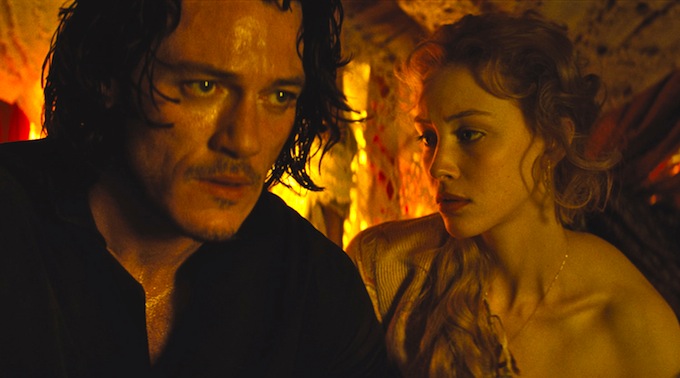
A moment from the film that was not 100% CGI.

A moment from the film that was not 100% CGI.

Dracula Untold: D

This is an outrageous clusterfuck of superhero origin movie clichés and Transformers 3 levels of CGI nonsense. I seriously couldn’t understand what was happening during the gushers of CGI, and when the camera stopped spinning long enough for me to get it, I was sorry that I did.

There is nothing “Dracula” about this movie. All of the seduction, complexity, and horror is erased completely. What remains is a seriously pathetic Dracula reboot attempt where the character is reimagined as a Batman (pun actually not intended) kind of avenger who, like the protagonist of every kung-fu movie and side scrolling video game, fights bad guys of increasing difficulty until the final battle scene with the “boss”. I suppose if you enjoy vampire movies and want to see a worse PG-13 version of one of those Underworld movies, where vampires do kung-fu, you might like this one. I think this is the only movie I have seen with Dracula in it where Dracula is just not fucking cool at all. He looks/behaves like the lead singer of Creed.

Tywin Lannister plays a cave-dwelling Nosferatu-ish vampire who gives Vlad his CGI abilities. This part is pretty cool. It’s a “deal with the devil” setup where Vlad has to gamble his soul in order to gain vamp-power. Lannisterferatu performs some CGI magic on him and then Vlad is able to do stuff like turn into a CGI swarm of bats, CGI heal from CGI attacks from CGI weapons, and movie at CGI super-speed. He can even create CGI tornados. The only thing he does that is not created by computers is his slow-motion walking/brooding in his trench coat that will make even devout Boondock Saints fans cringe.

There are a lot of “what have I become?” scenes and there is virtually no blood/gore in the battle scenes that interrupt Vlad’s pity party. Like another wretched monster reboot attempt, I, Frankenstein, the fight scenes are CGI-ed into blobs of spinning confusion and virtually all the killing blows are cropped out so that they can score that ever-sought-after PG-13 rating.

If you are someone who is generally unbothered by gratuitous CGI, and you like PG-13 action movies, give this a shot. But I just felt like I was watching a mixture of video games and sadder-than-John-Snow whining woven into what barely passes as a story.

REVIEW: Under the Skin (2013)

"Come with me if you want to not live."

“Come with me if you want to not live.”

Under the Skin: B-

Yes, this is the movie where Scarlett Johansson gets naked. Yes, it is also a pretty good movie that you should watch for reasons other than just the nude scenes. Again, yes, this is the movie where Scarlett Johansson gets naked.

What an extreme “don’t talk to strangers” cautionary tale. Johansson plays a seductive alien who drives around looking for dudes to lure back to her lair where she leads them into a vat of black goo that dissolves everything except their skin. You never see her do anything with their skin, but you know at some point she is going to wear it, or one of her alien homies is going to wear it. Underneath all that Johansson, is a really grotesque alien.

At first glance, the movie is really repetitive; the driving/seducing/goo takes up a good half of the film and the scenes are all really similar: Johansson drives up to whomever looks the loneliest, charms them into her van (and then to her lair), and then the next thing you know, the poor guy has a raging boner and is following naked Johansson (did I mention there are nude scenes?) until he realizes he’s in black goo, sinking like rock in quicksand. His face melts into disappointment; this was NOT covered in sex-ed!

What’s fun about this repetition is the tension. After you see one guy swallowed by the black goo, the rest of her seductions are rife with fucking evil dramatic irony. We know that if she gets a dude in the van, it’s black goo time, but all he can think about is naked Johansson, even though there is something sort of… off about her. All you can think about naked Johansson too, but you know there is also black goo. The music during the black goo parts is eerie and there are some uncomfortable first-person shots. I liked it.

What’s extra fucked up is the fact that a lot of the footage of her failing to convince a guy to hop in the van is actually footage of her asking real pedestrians, in real life, to hop in her van for a ride. A lot of guys turned Johansson down for a weird van ride and their nervous refusals are included in the film. So when you see her hungrily asking a dude to get in her van to hang out, and the guy says, “no Scarlett Johansson, I do not want to hang out with you,” it’s real! Fucking idiots.

Like I said, the drawn out and suspenseful seductions take up a lot of time, but the formula changes when the alien starts to have what appears to be an existential crisis. “Why am I getting naked and luring lonely guys into black goo?!” It doesn’t end well.

The majority of the director’s credits include music videos, which winds up being a good thing. The movie looks fucking awesome (Even scenes that don’t involve naked Johansson. There, I said it.). The shots are all carefully framed, there are those gnarly first-person sequences, and Johansson fluctuates between flawless and grotesque, angelic and demonic through isolating tracking shots and unflattering close-ups.

See it.

https://www.youtube.com/watch?v=NoSWbyvdhHw

REVIEW: 976-EVIL 2 (1991)

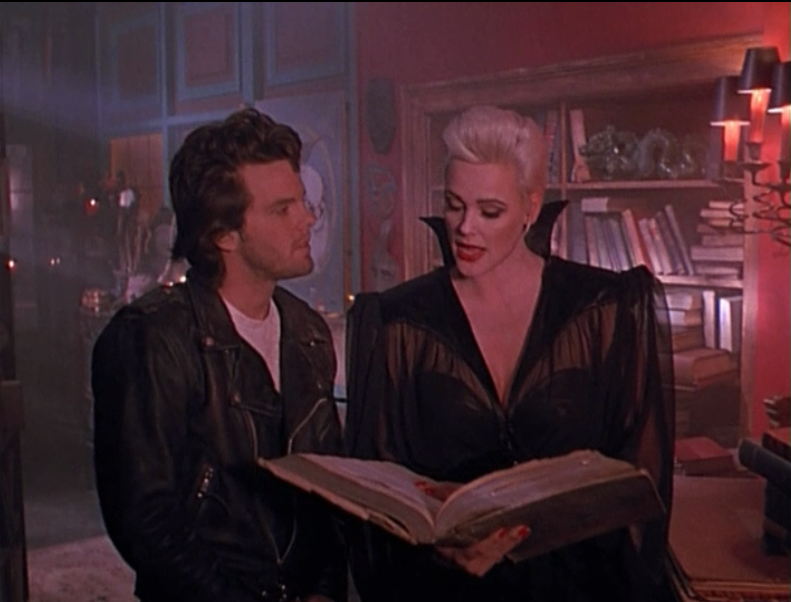
“Here is an ancient text that discusses 976-EVIL.”

976-EVIL 2: D-

Socrates: Glaucon, I have come across a mind-bending film called 976-EVIL 2. It tells the story of Spike, a wise-cracking motorcyclist, who finds himself entangled in a battle against a haunted jerk-off hotline. Have you encountered such a narrative?

Glaucon: Socrates, I am well aware of this film, but I have no experience with actual jerk-off hotlines – haunted or otherwise. I need you to accept this fact before we converse further. 

Socrates: Glaucon, I am your friend. I am perfectly willing to uphold your ridiculous jerk-off hotline denials and pretend that you are not a sick deviant so that we may discuss the film. 

Glaucon (sighs): Very well, Socrates… Where shall we begin? With the villain, perhaps? The story revolves around a teacher with, shall we say, “unsavory” tendencies who uses a supernatural jerk-off hotline to project himself onto the astral plane to commit heinous acts against blonde teenagers. Quite a distasteful premise, wouldn’t you agree?

Socrates: Indeed, Glaucon. And what do you make of this teacher’s preference for targeting blonde teens? Does it not raise questions about the origin of his motives and the depths of his depravity? Targeting this group so specifically speaks to pathological behavior often present in minds that dwell in the depths of sexual fetishes, like… your friend… whom we discussed at length while exploring the philosophical depravity of 976-EVIL, the genesis for this Satanic jerk-off hotline saga. 

Glaucon: Ah yes, my friend Epicurus who was ensnared in the unfortunate web of phone sex addiction back in 1988… A sad, sad tale that absolutely centered on his carnal jerk-off hotline impulses! I do not think this film is so complicated, Socrates. Perhaps the slaying of numerous young blondes is merely a cinematic choice fit for the genre, a means to generate suspense and shock value. After all, these filmmakers often rely on such cheap tactics to captivate the audience. If we suspend our disbelief to allow for an astral plane jerk-off hotline, why not suspend it further and accept the premise at face value?

Socrates: Perhaps, Glaucon. Yet, as the story unfolds, we encounter a multitude of unoriginal ideas and borrowed elements beyond the reuse of the demonic jerk-off hotline. The parallels to other films, such as Evil Dead 2 and Pleasantville, are evident and there is also a character who is a veritable carbon copy of Elvira, Mistress of the Dark with dyed blonde hair. Does this not suggest a lack of creativity and originality on the part of the filmmakers worthy of condemning this film?

Glaucon: Socrates, it is not uncommon for artists to draw inspiration from existing works; you know this. We’re talking about the filmmakers who are crafting a feature film around a magical jerk-off hotline! And besides, there are new and exciting ideas in this film: Spike is haunted by phones; they ring wherever he goes! There is a scene where they manage to blow up a truck! How did they get the money for this, Socrates? Let us not forget about when Spike kills himself so he can infiltrate the astral plane and combat the evil blonde-killing teacher. 

Socrates: Indeed, Glaucon, what you speak is true. I will concede that this is the first film I have seen in which a teen suicide leads to the creation of an anti-jerk-off phone sex ghost. I am willing to give this film a D-.

Glaucon: Agreed!

REVIEW: Christmas Evil (1980)

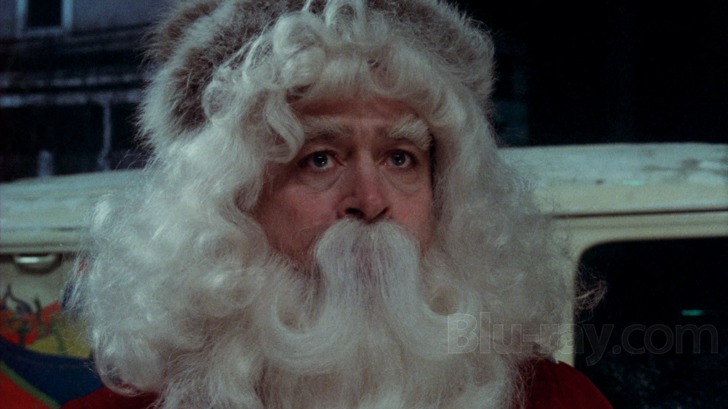
'Twas the night before Christmas, and all through the house, not a creature was stirring except Santa in his jack-off dungeon.

‘Twas the night before Christmas, and all through the house, not a creature was stirring except Santa in his jack-off dungeon.

Christmas Evil: B+

Christmas Evil has everything I look for in a good cult classic. It takes itself somewhat seriously, has abysmal acting from people trying as hard as they can to act, and has clichés before they were clichés. This was like a Taxi Driver Christmas Special. And before you get on your Silent Night, Deadly Night high horse, please note that Christmas Evil came out four years before SNDN…

Harry experiences some Christmas-related trauma as a young boy (he sees his father dressed as Santa, going down on his mom RIGHT NEXT TO THE CHRISTMAS TREE) and then grows up with a weird Christmas complex. He learns Santa isn’t a guy who comes down the chimney with a sack of toys, he’s a guy who smells like Pall Malls and does naughty things to your mom just 18 inches away from your stocking.

Harry grows up and gets a job at a toy factory and in his spare time, he spies on little girls and boys, keeping a genuinely creepy naughty/nice list. He also hums Christmas carols non-stop, builds his own custom dolls/action figures, and shuts out the outside world completely, effectively turning his home into his own demented South Pole.

The people at the toy factory start taking advantage of him even though it’s Christmas time. It’s very Dickensian. After an escalating series of minor abuses from coworkers and family members, Henry does the only thing that makes sense: He dresses like Santa and goes on a killing spree. “Naughty” people get attacked with a hatchet, “Nice” people get toys that Henry made after hours at the toy factory and in his South Pole jack-off dungeon.

There are some demented scenes of people getting slashed during midnight mass and another scene where Henry kills a guy in his bed on Christmas morning and then leaves behind toys for the guy’s kids. There are also some hilarious scenes of Harry hiding in bushes and driving around in a sex offender-y van, dressed like Santa, talking to himself.

At one point, some townsfolk form a mob, gather torches and weapons, and run around looking for Harry like some 18th century Carpathian villagers.

Henry is a likeable slasher who has a Travis Bicklian moral code he tries to stick to, but he is eventually undone by his own need to be a real-life Santa. I’ll leave it at that. This is a good slasher and I recommend you check it out.

https://www.youtube.com/watch?v=_uAMtjDXXhs

REVIEW: Neon Maniacs (1986)

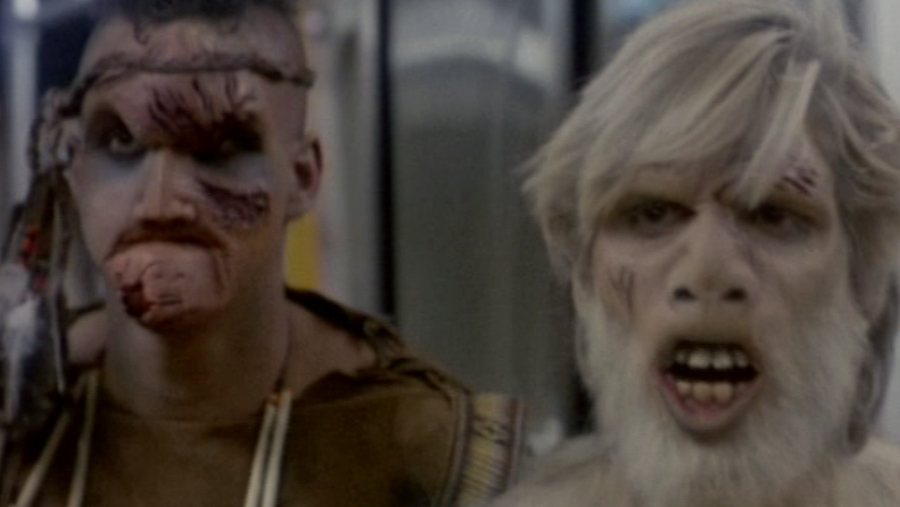
Make-up effects brought to you by the Halloween Spirit Store's 80% off sale.

Make-up effects brought to you by the Halloween Spirit Store’s 80% off sale.

Neon Maniacs: D-

There is a gang of humanoid mutants (or “maniacs”) living inside of the Golden Gate Bridge. At night, they roam the streets of San Francisco, killing random people and harvesting their body parts. The only person who knows this information is a typical Well-Behaved Young Girl who narrowly escapes their clutches. Guess what: no one believes her. Also, guess what: I don’t give a shit, this movie blows.

The maniacs are mostly lame, flirting with Mighty Morphin Power Rangers syndrome; they look sort of like variations of the Toxic Avenger, but they are supposed to be scary. Maybe two of the maniacs look like they have some cool make-up on, but the rest are some dudes with Halloween masks and garbage glued to them. I’m talking Halloween masks you buy at Target. The shit is so random! One guy looks like they threw flour on him and glued pubes all over him. What a shitty mutation.

Get ready to get pissed: The maniacs’ weakness is water. That’s right: The maniacs who live in a tower of the Golden Gate and who wander around San Francisco at night, where the atmosphere is all MOISTURE, are killed by fucking water. This is worse than Signs where the aliens who also have a weakness for water decide to invade Earth, a water planet, and they run around a dewy cornfield.

The maniacs wind up at a high school battle of the bands where everyone is wearing cheap Halloween costumes, so the maniacs fit right in. The Well-Behaved Young Girl convinces her friends to spray the maniacs with squirt guns and while 80’s rock plays and you are expected to just sit there and watch this garbage.

This is the “showdown” scene of the movie. There is a crescendo of low-budget and unamusing violence, limbs getting hacked off and off-screen kills galore, that is abruptly ended when some girl dressed as Dracula gets a hold of the firehose and sprays the maniacs to maniac Kingdom Come.

The movie almost didn’t get made and actually had some interesting people (like the guy who did make-up for Aliens) involved from time to time, and I guess because of all the hoopla that built up to Halloween costumed turds, this is considered a “cult” film. But I don’t buy it. I think it’s sloppy and cheap and fucking agonizing to watch. Maybe at one time, someone cared about Neon Maniacs, but you wouldn’t be able to tell by watching it.